


Greenhouse lighting: supply missing light with a defined objective
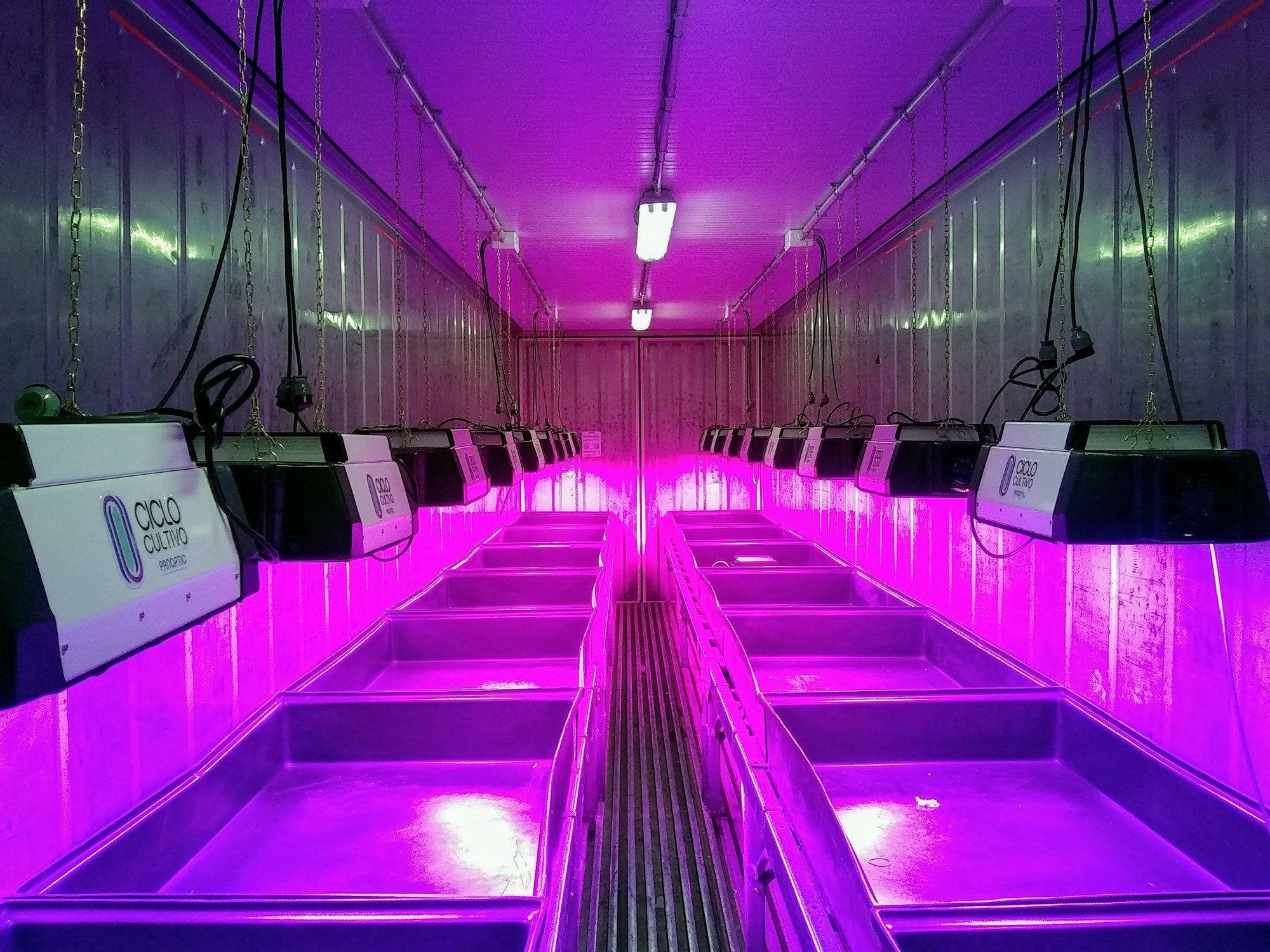
Greenhouse lighting is sized from the light received by the crop and the agronomic objective. PPFD describes instantaneous photon flux over a surface; DLI integrates that contribution throughout the day. Photoperiod describes the duration of light and darkness and requires a separate assessment.
Before selecting a luminaire, ask what it should achieve: more growth light, a different day length or conditions for a trial. These are different needs. Installed electrical power alone does not indicate how much useful light reaches the crop or whether the programme meets its objective.
Assessment should begin at plant height. The covering, structure, screens and crop arrangement affect radiation reaching each sector; an outdoor reading does not automatically represent the indoor environment. Purdue University: measuring greenhouse daily light integral.
PPFD, DLI and photoperiod: keep three measures separate
PPFD is photosynthetic photon flux density, measured in micromoles per square metre per second: µmol·m⁻²·s⁻¹. It is an instantaneous measurement over a surface. DLI sums the daily contribution in moles per square metre per day: mol·m⁻²·d⁻¹. Photoperiod describes the duration of the light period. MSU, The Lighting Guide.
For project planning, the first helps assess distribution and intensity; the second assesses daily quantity; the third defines a timing signal that can affect development. Document them separately so an instruction such as “provide more light” does not become an ambiguous decision.
An example of supplemental light contribution
If an installation supplies a constant 100 µmol·m⁻²·s⁻¹ for eight hours, its calculated contribution is:
100 × 8 × 3,600 / 1,000,000 = 2.88 mol·m⁻²·d⁻¹.
This is an illustrative calculation of lamp contribution based on the DLI definition, not a species recommendation or yield prediction. To estimate the crop total, add measured natural light and consider spatial distribution. The formula assumes constant intensity over the stated period. MSU: PPFD, hours and DLI.
Photoperiod lighting serves a different function
Photoperiod lighting usually uses low intensity to extend the day or interrupt the night. Supplemental lighting aims to increase daily light available for photosynthesis. Equipment suited to the first function may contribute little to the second. Erik Runkle: supplemental lighting strategies.
A technical enquiry should therefore identify whether the aim is regulating flowering, maintaining vegetative growth, increasing daily light availability or combining functions. Research specifications should also identify the condition being compared between treatments.
Measure distribution, not only the brightest point
Assess several representative points in each sector and record sensor height and position. A reading directly beneath a luminaire does not necessarily describe edges or aisles. If lamp height, plant distribution or screen position changes, measurements should be checked again.
This verification supports concrete project questions: how much light the system contributes, where and at what times. It also distinguishes insufficient installed capacity from poor distribution. Both can produce uneven plants but do not necessarily require the same intervention.
Choose technology for the installation
LED and HPS should be assessed within the growing system, considering distribution, consumption, spectrum, heat management, dimming and maintenance. Spectral response varies with crop and commercial objectives; no colour combination is universally superior. Erik Runkle: spectrum and electric-light production.
For investment decisions, request a distribution design, documented luminaire performance and estimated operating hours. Comparing only nominal power or purchase price overlooks operation during the crop cycle.
Assess crop results and consumption
Track received DLI, operating hours and energy consumption alongside a crop variable such as cycle duration, seedling quality or lot uniformity, according to the objective. Calculating light contribution cannot independently predict yield increases: temperature, nutrition, water and plant material also matter.
CiberAgro integrates lighting with greenhouse structures and environmental management. We start by defining the need and measuring existing conditions to size the contribution and coordinate it with screens and control.
Share your crop, location, area and lighting objective. We can assess missing information and a suitable configuration for your facility.
Frequently asked questions
Can I size the system using lamp wattage alone?
No. Watts indicate electrical consumption or power; photon contribution and distribution at crop height must also be known.
Is outdoor DLI the same as inside the greenhouse?
No. The covering, structure, equipment and screens change the light reaching plants.
Do longer operating hours always improve results?
No. Programmes must respect crop response, photoperiod objectives and other management conditions.
Apply these criteria: explore lighting and monitoring. Discuss your project.
Sources and scope of evidence
- Purdue, Measuring Daily Light Integral in a Greenhouse: measuring light inside the greenhouse.
- MSU, The Lighting Guide: PPFD, DLI and units; the arithmetic example is illustrative, not an experimental result.
- Runkle, Strategies for Supplemental Lighting: different lighting purposes.
- Runkle, Lighting plants indoors: spectrum and crop-dependent responses.