


Improve air renewal and distribution in your greenhouse
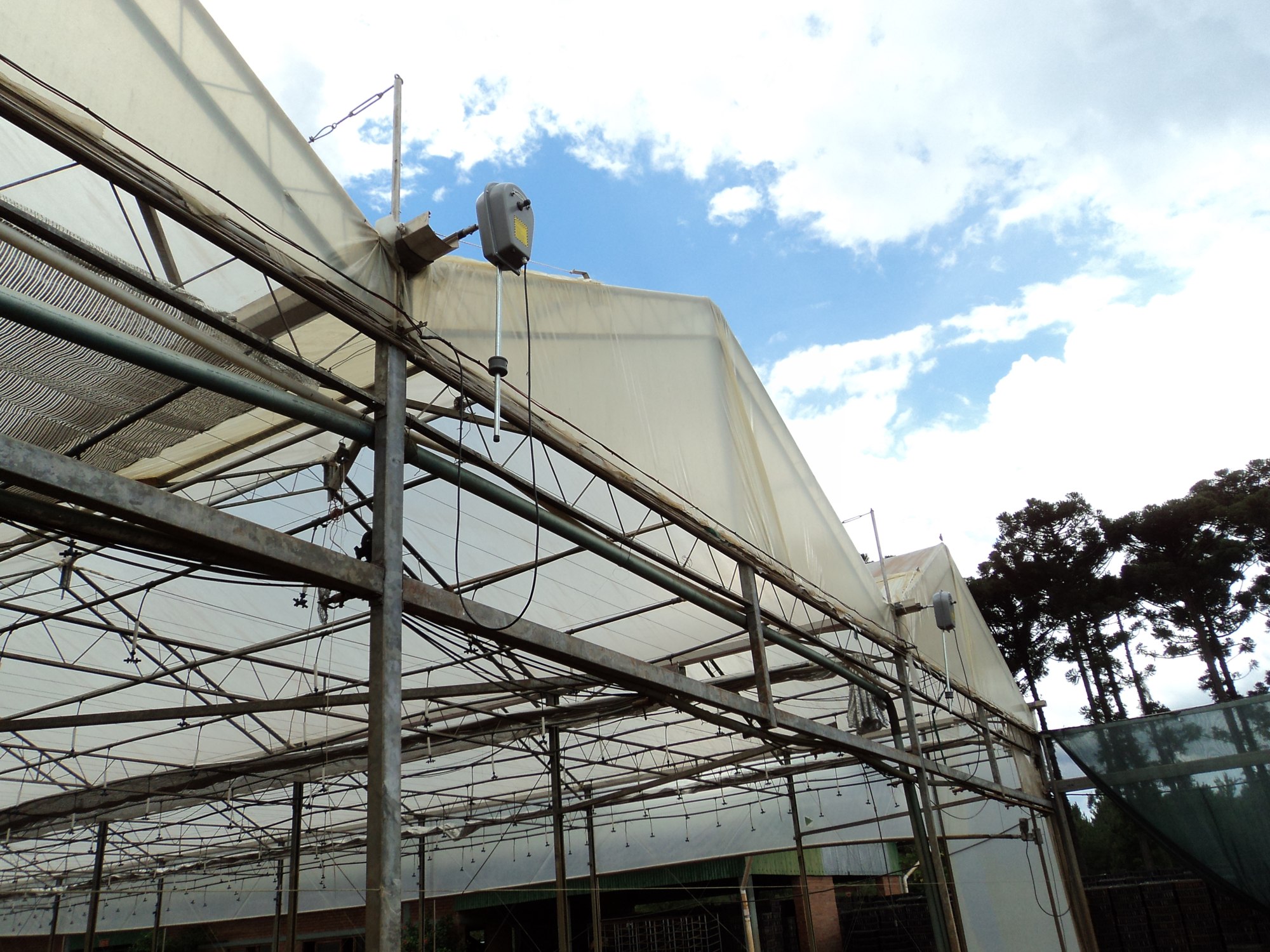
Good ventilation requires renewing the air and distributing it within the crop. Vents and exhaust fans exchange air with the outside; circulation fans help mix indoor air. These are different functions and should be designed as parts of one system.
One sector may be too hot while another remains more humid. An assessment based only on average temperature can overlook these differences. Before adding equipment, identify where heat accumulates, how air enters and the path it takes through the plants.
Renewing air is not the same as moving it
Natural ventilation uses wind and temperature differences to exchange air. Side and roof vents can work together: their location and area influence the result. Insect screens resist airflow, so they also belong in sizing and maintenance assessments. University of Florida IFAS, Greenhouse Ventilation.
Internal circulation has another purpose: reducing differences within the cultivated space. The New South Wales agricultural agency explains that air mixing helps prevent localised temperature and humidity accumulation. It also notes that environmental and irrigation uniformity influence crop uniformity. This supports assessing several sectors rather than only the entrance area. NSW DPIRD, Uniformity in the greenhouse.
Design the airflow path as well as the equipment
Exhaust ventilation needs adequate air inlets and a path through the crop area. An open door near the exhaust fan can alter that path. A fan’s nominal capacity alone does not describe actual airflow in the installation: system resistance and manufacturer technical information must be considered.
UMass Extension explains how exhaust fan locations, inlets and obstacles affect air distribution. It also recommends checking shutters, blades and belts: dirt or incomplete opening can restrict operation. UMass Extension, Ventilation for Greenhouses.
A site assessment should record width, length and height; available openings; orientation; crops and density; screen locations; existing equipment and outdoor conditions. This helps distinguish a capacity problem from a distribution problem.
Which benefits should be verified?
Improvement should be assessed through operational indicators. For a new project or extension, we propose recording:
- Temperature differences between sectors during the same interval.
- Time outside the environmental bands defined for the crop.
- Equipment operating hours and consumption, where metered.
- High-humidity events and condensation observations.
- Manual interventions needed to correct deviations.
These indicators do not automatically mean higher yields. They first establish whether the installation achieves the intended environment. Its relationship with uniformity, quality and production outcomes can then be analysed, while keeping records of other management changes.
Coordinating actions avoids isolated corrections
As a design example, an opening stage may precede an exhaust stage. The sequence must be defined for the structure, climate and management strategy. The same rule should not be applied to every facility.
Integration with Sinthesis can include measurements and control rules according to project sensors and actuators. Automation executes that technical criterion; it does not replace sizing or correct an insufficient air inlet.
At CiberAgro, the starting point is to assess the whole installation: vents, exhaust, circulation and their relationship with other equipment. Where persistent heat or humidity prompts an enquiry, a plan and records from several sectors help guide diagnosis.
Ask us how to improve ventilation in your greenhouse.
Frequently asked questions
Does a circulation fan renew the air?
Not by itself. It mixes indoor air. Renewal requires exchange with the outside through vents or exhaust ventilation with air inlets.
Can ventilation cool below outdoor temperature?
Air renewal alone does not provide that capacity. Additional needs may require other strategies, such as evaporative cooling, depending on environmental conditions. UMass Extension.
What information does CiberAgro need to assess an improvement?
Location, dimensions, crop, vents, existing equipment and a description of the problem. Environmental records and photographs of the airflow path complement the assessment.
Apply these criteria: explore ventilation and its relationship with monitoring. Discuss your project.
Sources and scope of evidence
- University of Florida IFAS, Greenhouse Ventilation: natural ventilation, openings and insect-screen resistance.
- NSW DPIRD, Uniformity in the greenhouse: air mixing and environmental uniformity.
- UMass, Ventilation for Greenhouses: distribution, maintenance and the cooling limit of air renewal.